
Introduction
Princess Alexandrine Irene of Prussia was a German princess whose life connected the history of the former German monarchy with the personal experiences of a woman living with Down syndrome in the twentieth century. Born on 7 April 1915 in Berlin, she was the daughter of Wilhelm, German Crown Prince, and Cecilie of Mecklenburg-Schwerin. Her grandfather was Kaiser Wilhelm II, the last German emperor, which placed her among the most prominent members of the House of Hohenzollern.
Despite her royal background, Alexandrine lived a relatively private life. She experienced the end of the German monarchy, the political instability of the interwar period, the Nazi era, the Second World War, and the transformation of Germany after 1945. These events shaped the historical environment in which she grew up and lived as an adult.
Known affectionately within her family as Adini, Alexandrine received specialised education and relied on continuing personal care. Her life is significant because it offers a different perspective on European royal history, moving beyond political power and royal succession to examine family relationships, disability, education, and personal circumstances.
Although detailed information about her private interests remains limited, the surviving historical record provides valuable insight into her family background, upbringing, and later years in Bavaria.
Early Life and Birth in Berlin
Princess Alexandrine Irene of Prussia was born on 7 April 1915 at the Kronprinzenpalais, also known as the Crown Prince’s Palace, in Berlin. Germany was fighting in the First World War at the time, and the country remained under the rule of Kaiser Wilhelm II.
Her birth took place in a household connected directly to the German imperial throne. Her father, Crown Prince Wilhelm, was the eldest son of the emperor and the expected successor to the throne. Her mother, Cecilie of Mecklenburg-Schwerin, belonged to another distinguished German royal family.
Alexandrine was given two formal names, Alexandrine Irene, following the naming traditions common among European aristocratic families. Within her immediate family, however, she was known as Adini. This affectionate nickname reflected the personal side of her identity beyond her formal title.
Her childhood began in an environment of royal traditions, aristocratic connections, and family expectations. However, her experiences differed from those of many other royal children because she had Down syndrome. At that time, medical knowledge about the condition was limited, and people with intellectual disabilities frequently encountered social prejudice and restricted educational opportunities.
Her family background provided access to resources that were unavailable to many ordinary German families. Nevertheless, her upbringing also required particular attention to her educational and personal needs. Her life consequently developed at the intersection of royal privilege and the challenges associated with disability in early twentieth-century Europe.
Parents and the House of Hohenzollern
Alexandrine’s father, Wilhelm, German Crown Prince, was born on 6 May 1882. As the eldest son of Kaiser Wilhelm II, he was expected to inherit the German imperial throne. However, the monarchy collapsed in November 1918 following Germany’s defeat in the First World War and the German Revolution.
Wilhelm never became emperor. Instead, he lived through the end of the imperial system and spent the remainder of his life as a former crown prince. He died in 1951, leaving behind a family whose position in German society had changed significantly since the days of the monarchy.
Alexandrine’s mother, Cecilie of Mecklenburg-Schwerin, was born on 20 September 1886. She married Wilhelm in 1905 and became the German Crown Princess. Through her family, Alexandrine was connected to the grand ducal house of Mecklenburg-Schwerin and to wider European aristocratic networks.
Her paternal grandparents were Kaiser Wilhelm II and Empress Augusta Victoria. Her maternal grandparents were Frederick Francis III, Grand Duke of Mecklenburg-Schwerin, and Grand Duchess Anastasia Mikhailovna of Russia. Alexandrine was also a great-great-granddaughter of Queen Victoria, whose descendants were connected to several European royal families.
These relationships gave Alexandrine a remarkable dynastic background. However, she did not occupy a political position or play a recognised role in royal succession. Her personal circumstances, family relationships, and continuing need for care were more central to her everyday life than the political ambitions traditionally associated with her family.
Siblings and Family Relationships
Alexandrine was the fifth child in a family of six children. She had four older brothers: Wilhelm, Louis Ferdinand, Hubertus, and Frederick. Her younger sister, Cecilie, was born in 1917.
Growing up in such a prominent household meant that Alexandrine belonged to a family whose history was closely connected to Germany’s political and cultural development. The children experienced the traditions of the imperial household before the monarchy ended, followed by the changes that came with the establishment of a republic.
Her brother Louis Ferdinand became particularly important in the family’s later history. Following the death of his father in 1951, he became head of the House of Hohenzollern. He also maintained contact with Alexandrine during her later years in Bavaria, visiting her regularly.
Her mother remained an important figure in her life as well. Historical accounts record that Cecilie visited Alexandrine in 1946, after the Second World War. These visits demonstrate that Alexandrine continued to have connections with her immediate family despite living separately from many of its members.
Alexandrine’s nickname, Adini, provides a glimpse of the more personal relationships within the household. While royal titles and family lineage often dominate accounts of the Hohenzollerns, her story also reflects the ordinary importance of affection, companionship, and family responsibility.
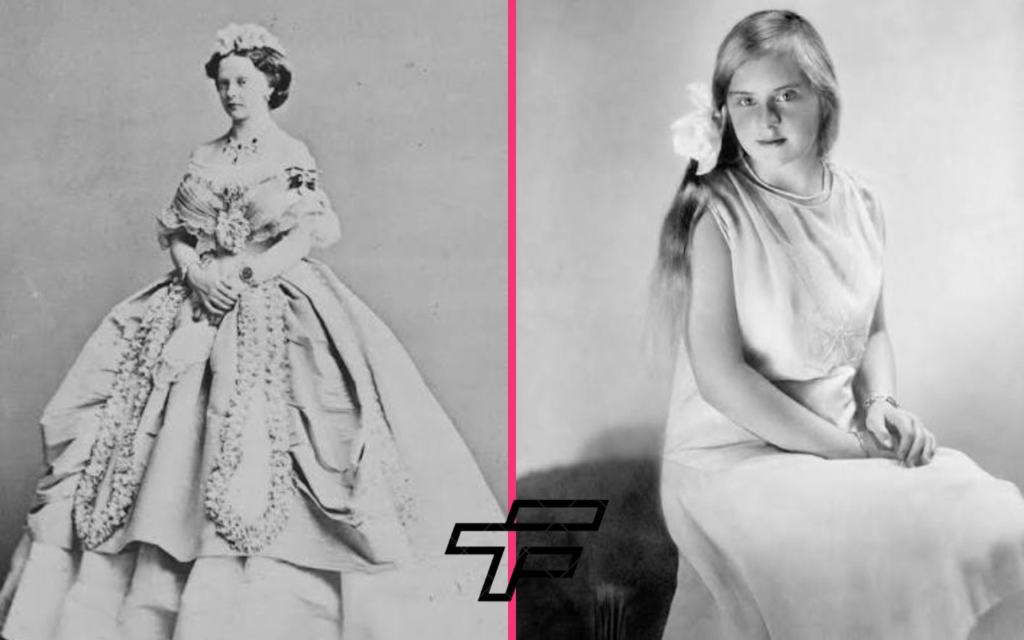
Photographs showing Alexandrine with her mother and younger sister have helped preserve evidence of her place within the family. These images are particularly valuable because they document her as a member of the household rather than defining her exclusively through her disability.
Living With Down Syndrome in the Early Twentieth Century
One of the defining aspects of Alexandrine’s life was her Down syndrome. During the early twentieth century, understanding of the condition was far more limited than it is today. Medical research, public awareness, and educational support for people with intellectual disabilities were still developing.
People with disabilities frequently faced discrimination and social exclusion. In some families, disabled relatives were kept away from public events because of prevailing social attitudes. Access to suitable education and independent participation in community life was also restricted.
Alexandrine’s experience attracted historical interest because she was not entirely hidden from public view. She appeared in family photographs and participated in certain family occasions. Her presence provides an example of how a prominent European family represented a member with a disability during a period when prejudice remained widespread.
Her family employed caregivers who supported her throughout different stages of her life. Selma Boese, her longtime nurse, played an important role in her earlier years. After Boese’s death in 1936, Alexandrine moved to Bavaria, where she continued to receive personal care.
Her royal background may have helped her family arrange specialised support, but it did not remove the broader limitations of the period. Modern understandings of disability rights, inclusive education, and independent living had not yet developed in their current forms.
Historical research into Alexandrine’s photographs and family life has examined the contrast between her visibility and the isolation experienced by many disabled people. Her biography therefore contributes to a wider discussion of disability, social attitudes, and the treatment of people with intellectual disabilities in twentieth-century Europe.
Education at the Trüpersche Sonderschule in Jena
Education was an important part of Alexandrine’s early adult life. From approximately 1932 to 1934, she attended the Trüpersche Sonderschule in Jena, an institution associated with specialised education for children and young people with additional learning needs.
The school was connected to the educational work of Johannes Trüper. Specialised institutions of this kind developed partly in response to the limited opportunities available to children who could not easily participate in ordinary classrooms.
Alexandrine attended the institution during her teenage years. Her education differed from the conventional schooling or private tutoring that many aristocratic children received. Instead, she studied in an environment intended to accommodate students with particular educational requirements.
The history of special education during this period is complex. Although such schools provided opportunities for some students, their methods and expectations were different from contemporary approaches to inclusive education. Nevertheless, their existence reflects an emerging recognition that children with disabilities could benefit from structured learning and individual support.
Alexandrine returned to Potsdam in the summer of 1934. Later that year, she celebrated her confirmation alongside her younger sister, Cecilie. The ceremony reflected the continuing importance of religious and family traditions in the Hohenzollern household after the end of the monarchy.
Unfortunately, detailed information about Alexandrine’s academic progress, favourite subjects, and friendships at school is scarce. It is therefore important to distinguish documented facts from assumptions about her experiences. What is clear is that specialised education formed a significant part of her upbringing.
The Fall of the German Monarchy and Political Change
Alexandrine was only three years old when Germany’s imperial monarchy ended in November 1918. The First World War had brought enormous suffering and economic pressure, and political unrest eventually led to the abdication of Kaiser Wilhelm II.
Germany became a republic, ending the Hohenzollerns’ formal role as the ruling imperial family. Alexandrine’s father lost his position as heir to the throne, and the household had to adjust to a society in which royal status no longer carried the same political authority.
During her childhood, Alexandrine spent time in family residences associated with the former imperial household, including Potsdam and Schloss Oels in Lower Silesia, now Oleśnica in Poland. These residences reflected the family’s aristocratic heritage and its continuing ties to historic properties.
The end of the monarchy did not immediately erase the family’s wealth, connections, or traditions. Nevertheless, its members had to navigate a very different political environment. The Weimar Republic experienced economic crises, social divisions, and political instability throughout the years between the two world wars.
The rise of Adolf Hitler and the Nazi Party brought further upheaval. When the Nazis established their dictatorship in 1933, German society entered a period marked by persecution, political repression, and state-sponsored violence.
Alexandrine was not known as a public political figure. Her life remained primarily connected to family relationships and personal care. Even so, the political developments surrounding her influenced the society in which she lived and the historical circumstances she experienced.
Life in Bavaria During the Nazi Era and Second World War
In 1936, following the death of her longtime nurse Selma Boese, Alexandrine moved to Niederpöcking in Bavaria. This change marked an important transition in her life, taking her away from the settings associated with her earlier childhood.
The move occurred during Nazi rule, a period in which the German government pursued eugenic policies and persecuted people with disabilities. The regime regarded many disabled people as burdens on society and organised the systematic murder of thousands through programmes associated with the so-called T4 operation.
The historical context makes Alexandrine’s continued survival and care particularly significant. However, the available evidence does not provide a complete account of how she experienced the Nazi period or precisely how her family arrangements affected her circumstances. It would be inaccurate to invent details about her safety or claim that her family played a specific political role in protecting her without reliable documentation.
Alexandrine lived privately in Bavaria during the Second World War, which began in September 1939 and ended in Europe in May 1945. Her life was centred on personal care rather than political activity or public appearances.
Her experience also illustrates the importance of understanding individual lives within broader historical events. Although she belonged to a former ruling family, her daily circumstances were different from those of relatives involved in public affairs.
After Germany’s defeat in 1945, the Nazi regime collapsed, and the country entered another period of transformation. Alexandrine remained in southern Germany, where she continued to receive care and maintain contact with members of her family.
Later Years Near Lake Starnberg
After the Second World War, Alexandrine continued living in Bavaria. In 1945, she moved into a small house near Lake Starnberg, an area south of Munich known for its lakeside communities and natural surroundings.
Her nurse, Ericka Strecker, provided support during this period. Alexandrine’s need for ongoing care remained an important part of her daily circumstances, and her living arrangements allowed her to continue life away from the more public settings associated with the former imperial family.
Her mother, Cecilie, visited her in 1946. Her brother Louis Ferdinand also visited regularly, maintaining a connection that continued despite the family’s changing circumstances and separate residences.
These relationships demonstrate that Alexandrine remained part of the family’s private life after the monarchy had disappeared. While other members of the Hohenzollern family attracted historical attention because of their dynastic status, her story was primarily one of family relationships and personal support.
The region around Lake Starnberg provided the setting for much of her later life. However, there is limited reliable information about her hobbies, friendships outside the family, daily routine, or personal opinions. Her biography is therefore best understood through the documented facts about her residence, education, caregivers, and relatives.
Alexandrine remained in Bavaria until her death in 1980. Her later years were quieter than the political and social upheavals that had characterised her childhood and early adulthood.
Death, Burial, and Historical Legacy
Princess Alexandrine Irene of Prussia died on 2 October 1980 in Starnberg, Bavaria, at the age of 65. Her life had spanned the German Empire, the Weimar Republic, Nazi Germany, the Second World War, and the establishment of postwar West Germany.
She was buried in the crypt at Hohenzollern Castle in Baden-Württemberg. The castle is closely associated with the House of Hohenzollern and remains an important historical monument connected with the dynasty’s long role in German history.
Alexandrine did not become a political leader or inherit the imperial throne. Her historical importance instead comes from what her life reveals about the personal experiences of a royal family during a period of major change.
Her biography also contributes to discussions of disability history. Her specialised education, continuing care, and appearance in family photographs provide evidence of how one disabled person lived within an elite household at a time when many people with intellectual disabilities faced exclusion.
Academic research has examined her story in connection with photographs, eugenics, and the social representation of disability. These studies place her individual experiences within a wider examination of European attitudes toward disabled people during the twentieth century.
At the same time, the limits of the surviving evidence must be acknowledged. Many details about her personality and everyday experiences remain unknown. Recognising these gaps makes it possible to tell her story accurately without turning speculation into historical fact.
Conclusion
Princess Alexandrine Irene of Prussia was more than a daughter of a German crown prince and granddaughter of an emperor. Her life offers a distinctive perspective on the history of the House of Hohenzollern and the changing circumstances of Germany during the twentieth century.
Born in Berlin in 1915, she grew up during the First World War and experienced the end of the monarchy as a young child. She received specialised education in Jena, lived through the Nazi era and the Second World War, and spent her later years in Bavaria with continuing support from caregivers and family members.
Known affectionately as Adini, Alexandrine remained connected to her family despite living separately from many of her relatives. Her death in 1980 and burial at Hohenzollern Castle marked the end of a life closely linked to both royal history and the personal realities of disability.
Her legacy lies in the intersection of these subjects. Alexandrine’s story reminds readers that the history of royal families is not limited to emperors, political events, and succession. It also includes individuals whose lives reveal the importance of education, family relationships, care, and dignity during times of profound social change.