
Introduction
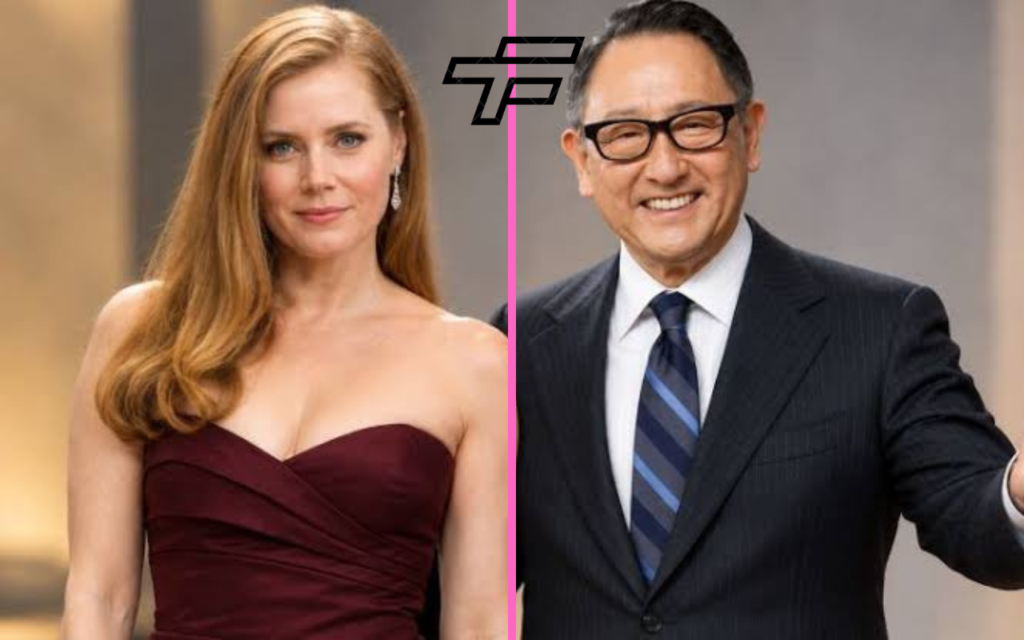
Amy Adams and Akio Toyoda are recognized for their achievements in two very different industries. Adams has established herself as one of Hollywood’s respected actresses through her performances in films, television productions, and dramatic roles. Toyoda has built his reputation in the automotive industry through decades of work at Toyota Motor Corporation, one of the world’s most influential automobile manufacturers.
Their professional journeys offer an interesting comparison between entertainment and business leadership. Adams has earned recognition for her versatility, emotional performances, and ability to portray a wide variety of characters. Toyoda is known for his connection to Toyota’s industrial heritage, his experience across different business operations, and his interest in developing vehicles that combine quality, innovation, and driving enjoyment.
Although their names appear together as a topic, there is no widely documented evidence of a significant personal relationship or direct professional collaboration between them. Their individual stories are worth exploring because they demonstrate how different skills, experiences, and ambitions can lead to success in very different fields.
Amy Adams: Early Life and Background
Amy Lou Adams was born on August 20, 1974, in Vicenza, Italy, while her father was serving in the United States military. Her family eventually moved to Castle Rock, Colorado, where she spent much of her childhood. Growing up in a large family provided experiences that later helped shape her understanding of relationships and human behavior, qualities that became useful in her acting career.
During her younger years, Adams developed an interest in performing arts. She initially considered pursuing ballet and trained as a dancer before discovering that musical theater offered a more suitable path. Her early involvement in stage performances helped her develop confidence, timing, and an understanding of how movement and expression communicate emotions.
Before becoming a familiar face in Hollywood, Adams worked in dinner theaters and participated in stage productions. These experiences provided practical training and helped her understand the discipline required to perform in front of live audiences. Unlike established film actors, she had to build her reputation gradually, gaining experience through smaller opportunities.
Her early career also demonstrated the importance of persistence. Acting opportunities were not always easy to obtain, and she faced the uncertainty common to people entering the entertainment industry. Rather than abandoning her ambitions, she continued developing her abilities and pursuing roles that could help her progress.
Amy Adams and Her Rise to Hollywood Fame
Adams began attracting wider attention with her performance in the independent film Junebug, released in 2005. She played Ashley Johnsten, a cheerful and emotionally open young woman whose personality contrasted with the more complicated relationships surrounding her. The performance received strong critical recognition and earned Adams an Academy Award nomination for Best Supporting Actress.
The success of Junebug helped establish her as an actress capable of delivering meaningful performances in smaller productions. She was not limited to glamorous or conventional Hollywood roles. Instead, she demonstrated an ability to portray characters with imperfections, emotional complexity, and believable personal experiences.
Her career reached a broader audience through Disney’s Enchanted in 2007. In the film, Adams played Giselle, a fairy-tale character who enters modern-day New York City. The role required her to combine comedy, singing, romance, and physical performance. Her portrayal helped make the film successful and demonstrated that she could lead a major studio production.
Adams subsequently appeared in films such as Doubt, Julie & Julia, and The Fighter. These projects allowed her to explore very different personalities and dramatic situations. Her performances earned additional recognition and established her as an actress who could move between independent cinema, mainstream entertainment, and serious drama.
Major Films and Acting Achievements
One of the defining characteristics of Amy Adams’s career is the range of roles she has undertaken. In The Fighter, released in 2010, she played Charlene Fleming, a woman connected to the complicated family life of boxer Micky Ward. The performance earned her another Academy Award nomination and demonstrated her ability to contribute to a powerful ensemble drama.
Her work in American Hustle in 2013 brought further recognition. The film explored deception, ambition, and complicated personal relationships, giving Adams an opportunity to portray a confident character operating in an unpredictable environment. She won the Golden Globe Award for Best Actress in a Motion Picture – Musical or Comedy for her performance and received an Academy Award nomination.
Another important project was Arrival, the 2016 science-fiction drama directed by Denis Villeneuve. Adams portrayed Louise Banks, a linguist asked to communicate with an alien species. Rather than relying primarily on action or spectacle, the film explored communication, memory, grief, and the human response to the unknown.
Her performance was central to the film’s emotional impact. It also illustrated how science-fiction stories can examine personal experiences and philosophical questions. Adams’s other notable films include Big Eyes, Nocturnal Animals, and Vice, each offering a different perspective on her acting abilities.
She also portrayed Lois Lane in DC films, including Man of Steel and Batman v Superman: Dawn of Justice. These roles introduced her to a large international audience and demonstrated her ability to work within major superhero franchises.
Akio Toyoda: Family History and Education
Akio Toyoda was born on May 3, 1956, in Japan. He comes from the family associated with Toyota’s industrial history. His grandfather, Kiichiro Toyoda, founded Toyota Motor Corporation’s automotive business, while his father, Shoichiro Toyoda, became an influential company leader. This family background gave Akio an early connection to the automotive industry, although his eventual responsibilities required extensive professional experience and management skills.
Toyoda graduated from Keio University in 1979 with a degree in law. He later moved to the United States to study at Babson College, where he earned a Master of Business Administration in 1982. His education gave him exposure to business management and international perspectives that would become useful throughout his career.
In April 1984, Toyoda joined Toyota Motor Corporation. He gained experience in several areas, including production, marketing, product development, and international operations. These responsibilities helped him understand the relationship between manufacturing quality, customer satisfaction, and business strategy.
One important stage of his career involved New United Motor Manufacturing, Inc., a joint venture between Toyota and General Motors in California. Beginning in 1998, Toyoda served as an executive vice president and board member there. The experience gave him a closer understanding of American manufacturing and the challenges of operating across different business cultures.
His progression through Toyota’s management structure eventually led to his appointment as company president in June 2009. Toyota’s official biography documents his advancement through these positions and his broad experience across automotive operations.
Akio Toyoda’s Leadership and Toyota’s Global Influence
When Toyoda became president in 2009, Toyota was facing significant challenges. The global financial crisis had placed pressure on the automotive industry, while quality concerns and vehicle recalls had created additional difficulties for the company. His leadership involved strengthening customer confidence, improving internal communication, and reinforcing the importance of product quality.
Toyoda frequently emphasized the idea that Toyota should make increasingly better cars. This philosophy reflected his belief that a manufacturer’s responsibility extends beyond selling vehicles. Reliability, safety, customer experience, and continuous improvement must remain central to product development.
He also developed a reputation for taking a personal interest in automobiles and motorsports. Under his influence, Toyota placed considerable emphasis on performance-oriented vehicles and racing activities as ways to improve engineering skills and encourage innovation.
Toyota’s approach to electrification has also attracted attention. The company became particularly successful with hybrid vehicles and continued exploring battery-electric vehicles, hydrogen technology, and other powertrain options. These decisions reflect the complexity of an industry in which manufacturers must consider environmental targets, infrastructure, affordability, and different customer needs.
Toyoda became chairman of Toyota Motor Corporation in April 2023, after serving as president for approximately 14 years. In September 2026, he was inducted into the Automotive Hall of Fame, recognizing his influence on the automotive industry and his contribution to Toyota’s development.
Comparing Their Careers and Lasting Impact
Amy Adams and Akio Toyoda illustrate how professional success can develop through different combinations of talent, education, experience, and perseverance. Adams built her reputation through performances that require emotional awareness, creative interpretation, and collaboration. Toyoda developed his career through business operations, manufacturing knowledge, strategic decisions, and leadership.
Their professional environments also involve different measures of achievement. In entertainment, an actor’s influence can be reflected in award nominations, memorable performances, audience engagement, and the lasting popularity of films. Adams’s work in Junebug, American Hustle, and Arrival demonstrates her ability to contribute to projects with very different themes and audiences.
In the automotive industry, leadership is measured through product quality, customer trust, operational performance, innovation, and long-term competitiveness. Toyoda’s career reflects the demands of guiding a multinational manufacturer through economic uncertainty and technological change.
Both careers also depend on teamwork. Films require contributions from directors, writers, production crews, and fellow actors. Automotive companies depend on engineers, designers, factory employees, suppliers, dealers, and many other professionals. Individual leaders and performers can influence outcomes, but their achievements are connected to the work of many people.
Their stories offer different lessons about professional development. Adams demonstrates the importance of developing a distinctive creative ability and continuing to explore new challenges. Toyoda’s career highlights the value of learning different parts of an organization and understanding how decisions affect customers and employees.
Are Amy Adams and Akio Toyoda Personally or Professionally Connected?
The shared topic of Amy Adams and Akio Toyoda may create curiosity about whether the actress and automotive executive have worked together or share a personal connection. However, there is no widely documented evidence establishing a significant relationship or direct professional collaboration between them.
Their careers are associated with different industries, and their public achievements have followed separate paths. Adams is known primarily for acting and producing screen projects, while Toyoda is recognized for his leadership in the automotive sector.
It is important to distinguish between two people appearing together in a topic and evidence that they have a meaningful connection. Without reliable information confirming a relationship, claims about a joint project, business partnership, or personal association would be speculative.
Nevertheless, comparing their careers remains a useful way to explore the different forms that achievement can take. Their backgrounds demonstrate how individuals can develop influence through creative work, business experience, and long-term dedication to their chosen professions.
Conclusion
Amy Adams and Akio Toyoda have established influential careers in two very different fields. Adams has become a respected Hollywood actress through her performances in films such as Enchanted, The Fighter, American Hustle, and Arrival. Her career reflects versatility, emotional depth, and a willingness to take on challenging roles.
Toyoda has spent decades working in the automotive industry, progressing through Toyota’s operational and management structures before becoming president in 2009 and chairman in 2023. His work has focused on product quality, customer confidence, manufacturing, and the future of mobility.
Although no significant public connection between them is established, their individual stories provide valuable insight into professional success. One has influenced audiences through storytelling and performance, while the other has helped guide a major international automotive company.
Ultimately, their careers show that achievement does not follow a single path. Creative ability, practical experience, adaptability, and collaboration can all help individuals make a lasting contribution to their respective industries.